1 year ago
Showing posts with label Kollywood. Show all posts
Tuesday, November 1, 2011
Whatever Happened to the Human Hero?
Good versus evil movies seem to be the in thing right now (not that that's new, but more so than ever it seems), but lately, unless you're a hero with superpowers, you'd better sit down, because you've just been schooled. I'm thinking in particular about two recent releases both advertised as full-on masala: Hindi movie RaOne (a sci-fi story about a game designer who creates a villain so evil he escapes the game and comes to wreak havoc in real life) and Tamil movie 7Aam Arivu (about an ancient healer and warrior whose lineage still carries enough of his DNA structure to make his resurrection possible). Both of these movies rely heavily on visual effects, CGI, and stunts, but the most important factor that unites them is that the heroes and the villains are not just your average humans, they have superpowers.
I came across a tweet from Allu Sirish (this random guy that I like to follow, from this random family who runs some random film company in Andhra Pradesh) that I will discuss for a little bit because I think it nails a very important point. I've taken the liberty to fill in the blanks on words that were shortened so here's the full version: Lots of Bollywood directors think that the "South formula" is over the top action, but they don't get it: it's the rawness. "Force" gets it right. I haven't seen Force, so that part of the tweet didn't matter to me, but I had an eureka moment reading the rest of it because I had been trying to explain this very simple concept myself for so long and could never find the right word: rawness.
I think it's a little like when people mock old school Bollywood by saying "Oh, do they still dance around trees?" and you're fuming inside because you know there's a whole layer of symbolism that they are dismissing with that sentence just because they don't get why the singing and dancing are a perfectly valid form of expression. (Funny how some of the same people go to the Opera and don't snicker: "Do they still trill all their lines?" But I digress.).
South Indian hero movies are something along the same lines: you just have to understand that it's not about the special effects, it's about communicating that rawness that Sirish talks about in a way that makes sense visually. And over the years the consensus has been that the best way to do that is to have the hero punch the rowdies across 20 feet of empty yard and into a house wall. Or a variation of that anyway. With that came a whole repertoire of gestures, phrases and stances that make up the vocabulary of a hero, so you see neck cracking, finger pointing, shouting, knuckle popping, and the ominous fist clenching, which always spells trouble for the rowdies. It's not hard to understand this vocabulary, in fact a 5 year old could get it, which is probably why their parents take them to see even the bloodiest movies in theatres, but you do have to have some minimal understanding for why it even exists. If not, you'll have a really hard time digesting any kind of masala, particularly the South Indian variety.
But now here's the problem with this: just because people have learned to suspend their disbelief and pretend to accept that you can in fact punch someone and they will fly into that pile of wood across the street, it doesn't mean they have to accept that anything is possible. All that power that is communicated through these stunts is nothing but a metaphor for the inner strength of the hero (or for the evilness of the villain). It will not, however, allow them to fly, change bodies or otherwise become a part of the X-Men. The hero still has to defeat evil in a one-on-one fight.
And I don't mean this kind of one-on-one:
This is exactly what newer movies, with the advent of VFX, seem to have forgotten. If anything, visual effects work against this basic concept of rawness because they deny the hero the opportunity to display his strength. The moment superpowers come in, the hero loses his humanity, and thus becomes alienated from me and you, which greatly diminishes his appeal (despite the rocking abs, sorry Surya, still love you though!).
Back to the movies I was talking about in the beginning, 7 Aam Arivu features a villain and a sometimes a hero who can hypnotise anyone into doing anything. As a consequence, much of the confrontational scenes see them standing 10 metres away from each other and using this neat little superpower to attack and/or escape. It's fun to watch, sure, but I am disconnected from it as the viewer because I simply cannot make that leap of faith, it's too big for me. All of a sudden, it's not just going from a realistic punch that knocks someone out, to a super-punch that also flies them in the air before knocking them out. Now I have to buy this whole new set of rules and why should I buy them when I have not been given a single articulate reason by the script?
Similarly in Ra.One, the battle is between a robot and a villain whose entire existence is based on artificial intelligence (and some mumbo jumbo they included in the script at the beginning of the movie to make it sound like it could somehow make sense). They mostly fight by throwing fireballs at each other and by exploding cars and trains around them. Again, with great "help" from an idiotic script that bored me to tears, there is no connection to be made with either of these characters. Ok, except for wanting to take Arjun Rampal home after seeing his yummy look as RaOne.
Not that I have anything against progress or the use of visual effects and technology to enrich the look of a movie, by all means, go all out. I do however have a problem with it when it kills the soul of the film, and it's becoming harder and harder to draw that line. Where does the CGI stop and where does the hero begin? In Ra.One I can safely say I did not even catch a glimpse of the hero, so that's an easy one. For the same reason its predecessor, Endhiran, did not appeal to me either. In 7aam Arivu you do get occasional good moments mostly because the hero is not superhuman until very late in the film, so that helps a lot. It's a shame that the script lets it down because 7aam Arivu did have good potential. It manages to slip under the door of entertaining, but just barely.
Now I know it really sounds like I am complaining against all that's new and shiny in Indian movies (though for everyone who has read this blog before it would be a well-known fact that I am not in the habit of doing that), but my bone of contention is strictly with the irresponsible usage of this new and shiny stuff. Give me a movie that has the hero and the villain fight it out in a battle of musical instruments (ask me if you don't know where that's from, it's a sure sign that you missed out on an awesome movie) and use all the special effects you want. And by all means, do have people fighting on top of trains! But if all they can do is throw cars at each other until one of them runs out of fuel... no thanks.
Until the day Bollywood (and its regional counterparts) learns that visual effects are a means to an end, not the end itself, I think I am off any sci-fi coming out of India. And the funny part is, I am pretty sure G.One himself says in the film that superheroes are made from the heart, it's not the hardware that matters but rather the humanity. Pity the movie did not practice what it preached. If only it had borrowed some of the philosophy behind Terminator 2 along with all those visuals...
PS: When they're done with that lesson, we'll move to script writing, screenplays that don't insult every adult's intelligence, and turning plot craters into gentle slopes, but for now... I am happy with baby steps.
Sunday, October 16, 2011
Mozhi Review... or an attempt at it
There are movies that I can go on talking about for days. And then there are movies that I can only say one word about: squeeee! I generally choose to not write about the latter category since you know... it would be embarrassing. But, in the case of Mozhi, an exception must be made because the Internet is outrageously barren when it comes to reviews of this wonderful little gem. And that just doesn't seem fair.
Mozhi is the story of two musicians and best friends, Karthik (Prithviraj) and Viji (Prakash Raj), who move in together in an apartment building. It's the strangest apartment building, with extremely modern, spacious living rooms,
but the bedrooms are so tiny that the two friends have to sleep together in the same bed, poor souls.
Perhaps also the reason why they are not too keen on having bachelors living there? No matter, the apartment plays host to the rest of their story as Karthik falls in love with deaf-mute neighbour Archana and thus our journey into the lives of the apartment building dwellers begins.
Archana (Jyothika) is a one-of-a-kind character. The movie gives her a unique treatment from the very start, and in fact she does fulfil the role of the strong, silent (no pun intended) and emotionally challenged hero, as opposed to the teary eyed heroine that usually embellishes the man's arm. She gets a hero-like introduction (the first time we see her she is kicking a drunkard's ass), and her intro song is a cross between your typical Mahesh Babu "I'm so badass" (TM) song and the sweet "She makes my heart go dhadak dhadak" heroine intro.
It's no surprise then that she is not only the central character of the film, but also its main hero.
Archana is deaf-mute from birth and she has seen her father abandon her mother because of that, which caused her to be extremely introverted, stubborn, and determined to stand on her own two feet. It also caused her to be apprehensive about men, particularly if they come with marriage proposals. This situation is, evidently, far from ideal for Karthik's budding love story.
Enter Sheela (Swarnamalya), Archana's best friend, who will not only act as a mediator between them, but she will also teach him sign language and a little bit about Archana's heart language. Aaaand she will have her own adorable story, but can't say too much about that because it will spoil the surprise.
On the surface this is a simple love story: boy meets girl, girl is not interested in boy, boy must work hard to woo girl, girl finally falls for him. But in a movie where everything goes against the norm, that's not even the beginning of it. One aspect that really interested me has to do with another role reversal: typically in a love story we see the girl being fascinated by everything that the hero says and does, while his interest in her "personality" is more of the physical/superficial variety. In Mozhi, Karthik doesn't fall for her looks or her femininity, he falls for her... well, badassness. As the story progresses, the more he discovers about her, the more he admires her for her strength, her pride and her self-respect.
This get mirrored on the heroine's side with a bit of a gender reversal as well. I particularly enjoyed the way Archana starts to take interest in music and rhythms as she gets to know Karthik, a very subtle but certain sign that she is becoming interested in him.
But underneath this, by starting to get in touch with a form of art that she never understood before, she is learning to understand him emotionally, something that, again, is behaviour usually reserved for the hero. It's not that the typical love story doesn't have a hero with emotions, but it's usually him that has to learn to understand her delicate feelings, him trying to learn the language of her soul, a language that he initially doesn't understand, not the other way around. We're used to the girls being the delicate flowers and the boys being the elephants in a china store. Mozhi does things just a little bit differently.
There are many little details like this that I really enjoyed in this movie, all having to do with modified mirror images. At one point Archana gifts Karthik a violin made of soap. It's a musical instrument, but it doesn't make any sounds. Later on, Karthik gifts her a pocket watch that plays a tune when opened. It's not a musical instrument, but it plays music. Through these gifts, she can now share his music, and he can share her silence.
I always said I appreciate love stories that change a character, that make them see the world in a different way, and this is one of the reasons why I am so in love with these characters: they don't come into each other's world just to live in it, they come to enrich it. By making an effort to learn each other's languages, both characters discover a side of their personality they never even knew they had. This is probably why the scene that touched me the most was Karthik's encounter towards the end with a little deaf-mute girl who is trying to sell him flowers. As empathic and kind as Karthik is from the very beginning, that entire conversation would have never taken place without Archana's presence in his life.
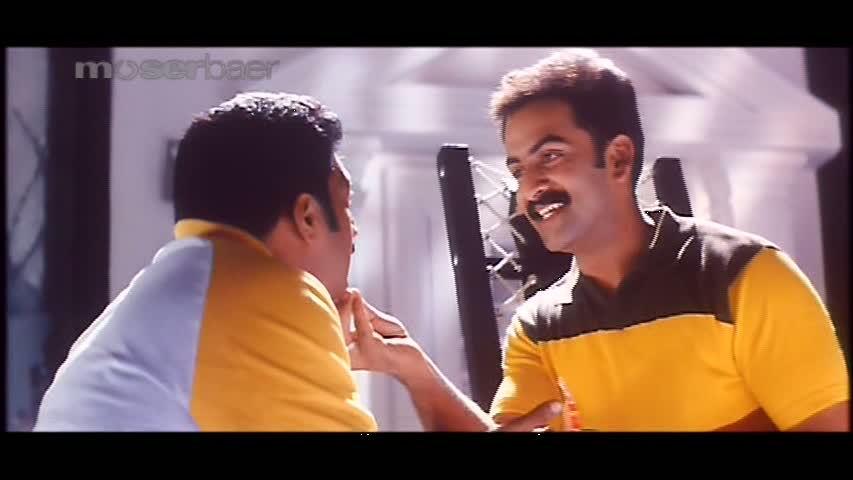
Now I realize that I have been talking incessantly about the main love story, but funnily enough, that's not even my favourite part of the film. My favourite part is the relationship between the two friends, Karthik and Viji. In fact Mozhi for me is as much a romance as it is a bromance, and the chemistry that Prithviraj and Prakash Raj share here is truly special. It's like watching two friends on candid camera, there is nothing forced in the way they laugh together, the way they poke fun at each other, the way they talk and learn from each other, and most of all the way they're always there for each other. I don't think I have ever seen either of the two actors in such jolly roles, and at such level of comfort, it really is like peeking through a hole into the real life of two roommates. They play off each so other brilliantly for comedy, that it's impossible not to grin happily during their scenes together.
Ah! Gold! Each and every one of their scenes! Such goofs!
Which actually brings me to a little something I wanted to say about Prakash Raj. Now I know he's been in some hundred of films, but why is it that there are only a handful where he plays a character different from Prakash-Bad and Prakash-Dad? If there was any doubt, Mozhi proves that he can do it and well, so I confess to being a little disappointed with him for not doing more with this talent. Not that I don't appreciate Prakash-Dad and Prakash-Bad, God knows I will watch a bad movie if he is the villain any day, but films like Mozhi and Iruvar make me sad to see him typecast so much.
Speaking of wasted potential, I am not Jyothika's biggest fan, but she truly made this role one of her best performances. Such a shame that she gave up acting after this film. She seems to have trouble emoting sometimes (and a few times in this film), but the fact that she made the sign language work so fluently for her character and pulling off a role where she has no lines, is indeed commendable. I quite enjoyed her in this film, as I enjoyed her sidekick, Swarnamalya.
It would not be a complete review if I didn't mention all the secondary characters, neighbours from the apartment complex, but then, this was never meant to be a proper review, nor do I want to spoil some of the surprises by bringing them up here. Suffice to say, it's a pleasure to see some well-developed secondary characters who are not there to move the plot forward necessarily, but rather to populate and enrich a world that becomes more real with each of them.
Now that Mozhi is available on DVD with subtitles, there is no excuse for not watching it. Besides, how often do you hear me rave so much about a love story, huh?
![]() |
| Don't worry, it's not as cheesy as the poster makes it seem! |
Mozhi is the story of two musicians and best friends, Karthik (Prithviraj) and Viji (Prakash Raj), who move in together in an apartment building. It's the strangest apartment building, with extremely modern, spacious living rooms,
but the bedrooms are so tiny that the two friends have to sleep together in the same bed, poor souls.
Perhaps also the reason why they are not too keen on having bachelors living there? No matter, the apartment plays host to the rest of their story as Karthik falls in love with deaf-mute neighbour Archana and thus our journey into the lives of the apartment building dwellers begins.
Archana (Jyothika) is a one-of-a-kind character. The movie gives her a unique treatment from the very start, and in fact she does fulfil the role of the strong, silent (no pun intended) and emotionally challenged hero, as opposed to the teary eyed heroine that usually embellishes the man's arm. She gets a hero-like introduction (the first time we see her she is kicking a drunkard's ass), and her intro song is a cross between your typical Mahesh Babu "I'm so badass" (TM) song and the sweet "She makes my heart go dhadak dhadak" heroine intro.
It's no surprise then that she is not only the central character of the film, but also its main hero.
Archana is deaf-mute from birth and she has seen her father abandon her mother because of that, which caused her to be extremely introverted, stubborn, and determined to stand on her own two feet. It also caused her to be apprehensive about men, particularly if they come with marriage proposals. This situation is, evidently, far from ideal for Karthik's budding love story.
Enter Sheela (Swarnamalya), Archana's best friend, who will not only act as a mediator between them, but she will also teach him sign language and a little bit about Archana's heart language. Aaaand she will have her own adorable story, but can't say too much about that because it will spoil the surprise.
On the surface this is a simple love story: boy meets girl, girl is not interested in boy, boy must work hard to woo girl, girl finally falls for him. But in a movie where everything goes against the norm, that's not even the beginning of it. One aspect that really interested me has to do with another role reversal: typically in a love story we see the girl being fascinated by everything that the hero says and does, while his interest in her "personality" is more of the physical/superficial variety. In Mozhi, Karthik doesn't fall for her looks or her femininity, he falls for her... well, badassness. As the story progresses, the more he discovers about her, the more he admires her for her strength, her pride and her self-respect.
This get mirrored on the heroine's side with a bit of a gender reversal as well. I particularly enjoyed the way Archana starts to take interest in music and rhythms as she gets to know Karthik, a very subtle but certain sign that she is becoming interested in him.
But underneath this, by starting to get in touch with a form of art that she never understood before, she is learning to understand him emotionally, something that, again, is behaviour usually reserved for the hero. It's not that the typical love story doesn't have a hero with emotions, but it's usually him that has to learn to understand her delicate feelings, him trying to learn the language of her soul, a language that he initially doesn't understand, not the other way around. We're used to the girls being the delicate flowers and the boys being the elephants in a china store. Mozhi does things just a little bit differently.
There are many little details like this that I really enjoyed in this movie, all having to do with modified mirror images. At one point Archana gifts Karthik a violin made of soap. It's a musical instrument, but it doesn't make any sounds. Later on, Karthik gifts her a pocket watch that plays a tune when opened. It's not a musical instrument, but it plays music. Through these gifts, she can now share his music, and he can share her silence.
I always said I appreciate love stories that change a character, that make them see the world in a different way, and this is one of the reasons why I am so in love with these characters: they don't come into each other's world just to live in it, they come to enrich it. By making an effort to learn each other's languages, both characters discover a side of their personality they never even knew they had. This is probably why the scene that touched me the most was Karthik's encounter towards the end with a little deaf-mute girl who is trying to sell him flowers. As empathic and kind as Karthik is from the very beginning, that entire conversation would have never taken place without Archana's presence in his life.
Now I realize that I have been talking incessantly about the main love story, but funnily enough, that's not even my favourite part of the film. My favourite part is the relationship between the two friends, Karthik and Viji. In fact Mozhi for me is as much a romance as it is a bromance, and the chemistry that Prithviraj and Prakash Raj share here is truly special. It's like watching two friends on candid camera, there is nothing forced in the way they laugh together, the way they poke fun at each other, the way they talk and learn from each other, and most of all the way they're always there for each other. I don't think I have ever seen either of the two actors in such jolly roles, and at such level of comfort, it really is like peeking through a hole into the real life of two roommates. They play off each so other brilliantly for comedy, that it's impossible not to grin happily during their scenes together.
Ah! Gold! Each and every one of their scenes! Such goofs!
Which actually brings me to a little something I wanted to say about Prakash Raj. Now I know he's been in some hundred of films, but why is it that there are only a handful where he plays a character different from Prakash-Bad and Prakash-Dad? If there was any doubt, Mozhi proves that he can do it and well, so I confess to being a little disappointed with him for not doing more with this talent. Not that I don't appreciate Prakash-Dad and Prakash-Bad, God knows I will watch a bad movie if he is the villain any day, but films like Mozhi and Iruvar make me sad to see him typecast so much.
Speaking of wasted potential, I am not Jyothika's biggest fan, but she truly made this role one of her best performances. Such a shame that she gave up acting after this film. She seems to have trouble emoting sometimes (and a few times in this film), but the fact that she made the sign language work so fluently for her character and pulling off a role where she has no lines, is indeed commendable. I quite enjoyed her in this film, as I enjoyed her sidekick, Swarnamalya.
It would not be a complete review if I didn't mention all the secondary characters, neighbours from the apartment complex, but then, this was never meant to be a proper review, nor do I want to spoil some of the surprises by bringing them up here. Suffice to say, it's a pleasure to see some well-developed secondary characters who are not there to move the plot forward necessarily, but rather to populate and enrich a world that becomes more real with each of them.
Now that Mozhi is available on DVD with subtitles, there is no excuse for not watching it. Besides, how often do you hear me rave so much about a love story, huh?
Labels:
Jyotika,
Kollywood,
Mozhi,
Prakash Raj,
Prithviraj,
Radha Mohan
Thursday, April 28, 2011
Mouna Ragam or How Getting a Beating Gets You the Girl
Mouna Ragam comes highly recommended for the rather poorly represented genre of "love after marriage" films. And what with it being a Mani Ratnam film (I know, I keep trying to get it and keep failing, but hope springs eternal), plus having a soundtrack by Ilaiyaraja who is on his way to becoming a huge favourite, of course I had to give it a shot.
Not many films would get such contrasting ratings from me for the two halves, so for this alone Mouna Ragam stands out. Unfortunately this also means I have to throw in more spoilers than I usually do, but without spoilers for the first half I could never talk about the loveliness of the second half, so I have no choice in this one.
I apologise in advance for the shoddy quality of my screencaps (and for the scarcity) but this DVD must be among the worst I have seen. Which is a shame especially because there are 2 or 3 songs that would have deserved much better print quality.
However, judging by the quality of some youtube videos, I think it's safe to assume I ended up with a very pirated copy which makes me sad, but partly explains the shortcomings of my DVD.
But enough whining, the movie! Well I knew it was made in the 80s, and it sure looks it, but it always amazes me to see how far back this stereotype of "wooing a girl with a technique that eerily resembles eve teasing" goes. I'll get to that in a minute but first I want to talk a little about my reactions to the heroine during the first part of the film. The girls sure had a lot to say about this one!
The film starts with the heroine, Divya (played by a certain Revathy who reminds me half of Asin and half of Scarlett Johansson), being told that a potential groom is coming to see her. She reacts rather vehemently and refuses to "be seen" because she finds the practice antiquated and wants to focus on her studies.
She ends up seeing him anyway because he waited for 5 hours at her place. This of course establishes him as a "carrect match" in the eyes of the family immediately. During their first conversation she tells him about all her defects encouraging him to just drop it and refuse the match.
Actually their first meeting is all kinds of adorable with her fussing with her beautiful yellow sari telling him about her shortcomings and him sitting and not being able to get a word in.
But horror of horrors he is a sucker for punishment and says yes. She on the other hand still refuses and stands up to her father when asked to reconsider her refusal. As a consequence we apply the age old formula with German efficiency and 100% success rate for getting the stubborn girl to say yes: heart attack!
Oh yes. What's a girl to do when the whole family blames her refusal of an arranged marriage for the father's minor heart attack? Don't blame it on the fatty food drenched in ghee, don't blame it on stress from work, don't blame it on a weak and potentially unexercised body. Nope, blame it on the girl!
Divya reluctantly moves to her husbandspalace home in Mumbai and this is where the film really begins. The groom by the way is a very pleasant man, played by Mohan, who looks a little stunned for most of the film, but we forgive him because he's just... cho chweet! In other films maybe I would have considered him annoyingly perfect, but there's something about his demeanour in general that goes hand in hand with his sweetness, so I fell for it hook line and sinker. He tries his hardest to please his new bride and demonstrates more patience than most people could ever be capable of. I did however appreciate the change in him after they decide to "part ways" and his passive aggressive silent treatment had me cheering. I thought he'd be another one of those doormat type characters, willing to do everything and anything for the obnoxious wife, but was happy to be proved wrong.
So now we finally find out why Divya was really against this marriage.
The subsequent flashback from Divya's past reinforces this seemingly harsh conclusion. The story goes like this: Divya gets a man arrested for rowdyism and theft without realizing that he was stealing for a good cause and from bad people.
But that's not the end of the girls' woes during this first half. So after Divya gets the man arrested, she finds out why he had done it and repents. She proceeds to doing everything she can to get him out of jail. By this point he has been in 2 fights: one where he kicked ass and one where he was thrashed (by the police). He has also taken two opportunities to wink at Divya. I'm not sure whether it was the second fight, the one where he presumably gets pounded, or the second wink, but by now he feels like he has already won the heart of his lady love. The fact that she's still telling him to leave her alone bears no weight of course, we all know she's just playing hard to get.
Dolce: Now you're really starting to talk like an aunty. All you were missing was the word kismat. Let's just let it be and focus on the more important parts of the story, eh?
Without getting into too many details about this flashback story that managed to seriously annoy me, we finally come to the good part of the film. I know, who knew it would ever come?
I started liking Chandra Kumar more and more in the second half, and especially loved his dignified attitude towards a situation that he did everything in his power to prevent. Sure, the dialogues give him the opportunity to shut his wife up with her own hateful lines from the first part of the movie in a way that looks like choreographed volleyball - with the ball always getting perfectly set for the winning spike - but somehow I even loved that.
Besides it's not just the beating this time around, it's Divya starting to really see her husband's qualities instead of focusing on her long lost love. In that train of thought, this is my favourite picturization, though they really overdo the close-ups of the hero and heroine looking up at each other. I think we got it the first 5 times around, Mani-ji. Oh, wait, I forget, it IS Mani Ratnam after all. Unless he slaps you with a dead fish over the face he doesn't feel that you got the message.
Still... such a beautiful picturization!
This is the half that makes the film worth while and the awkward interactions between the leads as they keep building and breaking their fragile relationship are a joy to watch. These are the moments when I wish my print was better because I'm sure I missed a lot of subtleties in the long looks that the two exchange. If the whole movie had been about those two I would have happily rewatched it over and over.
None of the marvelous songs were subtitled on my DVD, but such is the magic of Ilaiyaraja's music that it finds its way into your heart without even a word translated. My favourite song of the soundtrack doesn't even have a great picturization, but it still rocks my world.
Mouna Ragam won't be getting any awards for suspense, as it manages to be quite predictable, but the second half gets all my love for some great scenes between the two leads, which almost... almost make me forgive the tresspasses of the first half.
So what's the verdict?
Instead of a cheese rating, I'll do a quick recap of what we have learned from this movie:
1) That stealing is ok as long as it's for a noble purpose and only from the rich and sinners.
2) That stalking the girl and getting beaten up in front of her will make her heart melt for you.
3) That you can be a great guy and will still lose in front of the rowdy who got beaten up before you, BUT
4) That if in turn you get a good thrashing as well, that will exponentially improve your chances to make the girl love you.
And some good things? Sure!
5) That Ashutosh Gowariker stole half of the scenes in this movie when he made Jodhaa Akbar (definitely the wedding night scene)
6) That there is a better version of Gone With the Wind and it's Mouna Ragam!
7) That Ilaiyaraja deserves all the love he keeps getting and then some!
8) That there is yet hope for Mani Ratnam if he manages to focus on only one story at a time. For my taste the whole back story of the long lost lover could have been completely done without, leaving room for more of the delightful moments in the second half.
Despite all its faults, I did like the film and would whole heartedly recommend it for the second half which is vastly superior to the first half.
Not many films would get such contrasting ratings from me for the two halves, so for this alone Mouna Ragam stands out. Unfortunately this also means I have to throw in more spoilers than I usually do, but without spoilers for the first half I could never talk about the loveliness of the second half, so I have no choice in this one.
I apologise in advance for the shoddy quality of my screencaps (and for the scarcity) but this DVD must be among the worst I have seen. Which is a shame especially because there are 2 or 3 songs that would have deserved much better print quality.
However, judging by the quality of some youtube videos, I think it's safe to assume I ended up with a very pirated copy which makes me sad, but partly explains the shortcomings of my DVD.
But enough whining, the movie! Well I knew it was made in the 80s, and it sure looks it, but it always amazes me to see how far back this stereotype of "wooing a girl with a technique that eerily resembles eve teasing" goes. I'll get to that in a minute but first I want to talk a little about my reactions to the heroine during the first part of the film. The girls sure had a lot to say about this one!
The film starts with the heroine, Divya (played by a certain Revathy who reminds me half of Asin and half of Scarlett Johansson), being told that a potential groom is coming to see her. She reacts rather vehemently and refuses to "be seen" because she finds the practice antiquated and wants to focus on her studies.
She ends up seeing him anyway because he waited for 5 hours at her place. This of course establishes him as a "carrect match" in the eyes of the family immediately. During their first conversation she tells him about all her defects encouraging him to just drop it and refuse the match.
Dolce and Namak: Wah wah wah! How ballsy!
Actually their first meeting is all kinds of adorable with her fussing with her beautiful yellow sari telling him about her shortcomings and him sitting and not being able to get a word in.
But horror of horrors he is a sucker for punishment and says yes. She on the other hand still refuses and stands up to her father when asked to reconsider her refusal. As a consequence we apply the age old formula with German efficiency and 100% success rate for getting the stubborn girl to say yes: heart attack!
Dolce and Namak: Oh nooooooo!
Oh yes. What's a girl to do when the whole family blames her refusal of an arranged marriage for the father's minor heart attack? Don't blame it on the fatty food drenched in ghee, don't blame it on stress from work, don't blame it on a weak and potentially unexercised body. Nope, blame it on the girl!
Divya reluctantly moves to her husbands
So now we finally find out why Divya was really against this marriage.
Namak: So all those principles that we cheered for in the beginning were just a cover-up?
Dolce: Seems so.
Namak: And the only reason why she didn't want to marry this super nice guy is because she was in love with a rowdy?
Dolce: Well...
Namak: She's not revolutionary then, she's just dumb!
Dolce: Yi-yeeeeah.
The subsequent flashback from Divya's past reinforces this seemingly harsh conclusion. The story goes like this: Divya gets a man arrested for rowdyism and theft without realizing that he was stealing for a good cause and from bad people.
Namak: You know, all of a sudden it's not as surprising to read about all the corruption in India when people get fed films like this where theft is presented as acceptable as long as it's from rich and evil people in order to help good poor people.
Dolce: I hardly see how this (admittedly overindulged) Robin Hood complex is an excuse for corruption though.
Namak: Because, my dear, if we don't consider theft punishable at all times, what's to stop me from considering the tax payers as the rich and evil people and myself as the poor good person? Presenting something illegal as acceptable in one context opens the door for a million other contexts where it can be tweaked to one's advantage, no?But that's not the end of the girls' woes during this first half. So after Divya gets the man arrested, she finds out why he had done it and repents. She proceeds to doing everything she can to get him out of jail. By this point he has been in 2 fights: one where he kicked ass and one where he was thrashed (by the police). He has also taken two opportunities to wink at Divya. I'm not sure whether it was the second fight, the one where he presumably gets pounded, or the second wink, but by now he feels like he has already won the heart of his lady love. The fact that she's still telling him to leave her alone bears no weight of course, we all know she's just playing hard to get.
![]() |
| One of the many stalking moments |
Namak: Aha! Which brings me to another major issue in India (according to the papers anyway) that seems to be fed by movies like this: eve teasing. How exactly is a guy supposed to grow up knowing that "no" means "no" when so many movies use emotional blackmail and stalking as a sure method to get the girl? I mean, if I were a dude growing up in India why would I NOT try that? Clearly all the girls in the movies like it, the ones in real life must like it too. They're just saying they don't, right?
Dolce: But to be fair this one was more subdued in his approach, no? He doesn't really force himself on her, he just follows her around.
Namak: All while explaining to her that "she already loves him, she just needs to admit it" (this is where the emotional blackmail comes into play too, twice!). So what, that's not bad enough? After all, at this rate if she keeps saying no and you keep pursuing her, when do you start taking her refusal seriously? Before or after you grope her? Before or after the forced kiss? Before or after the rape?
Dolce: Well, at least unlike other movies on the topic, we know he won't be the right guy for her in the end.
Namak: Yes, thankfully but the scriptwriters also made sure to glorify him before getting rid of him, AND to have the girl weeping her heart out after him. It's only her good luck that a decent guy like Chandra Kumar came along. Dolce: Now you're really starting to talk like an aunty. All you were missing was the word kismat. Let's just let it be and focus on the more important parts of the story, eh?
Without getting into too many details about this flashback story that managed to seriously annoy me, we finally come to the good part of the film. I know, who knew it would ever come?
I started liking Chandra Kumar more and more in the second half, and especially loved his dignified attitude towards a situation that he did everything in his power to prevent. Sure, the dialogues give him the opportunity to shut his wife up with her own hateful lines from the first part of the movie in a way that looks like choreographed volleyball - with the ball always getting perfectly set for the winning spike - but somehow I even loved that.
Namak: Should we even mention that once again the hero getting beaten up works its magic on the girl?
Dolce: We could, but I think we've complained enough about that one already, na?Besides it's not just the beating this time around, it's Divya starting to really see her husband's qualities instead of focusing on her long lost love. In that train of thought, this is my favourite picturization, though they really overdo the close-ups of the hero and heroine looking up at each other. I think we got it the first 5 times around, Mani-ji. Oh, wait, I forget, it IS Mani Ratnam after all. Unless he slaps you with a dead fish over the face he doesn't feel that you got the message.
Still... such a beautiful picturization!
This is the half that makes the film worth while and the awkward interactions between the leads as they keep building and breaking their fragile relationship are a joy to watch. These are the moments when I wish my print was better because I'm sure I missed a lot of subtleties in the long looks that the two exchange. If the whole movie had been about those two I would have happily rewatched it over and over.
None of the marvelous songs were subtitled on my DVD, but such is the magic of Ilaiyaraja's music that it finds its way into your heart without even a word translated. My favourite song of the soundtrack doesn't even have a great picturization, but it still rocks my world.
Mouna Ragam won't be getting any awards for suspense, as it manages to be quite predictable, but the second half gets all my love for some great scenes between the two leads, which almost... almost make me forgive the tresspasses of the first half.
So what's the verdict?
Instead of a cheese rating, I'll do a quick recap of what we have learned from this movie:
1) That stealing is ok as long as it's for a noble purpose and only from the rich and sinners.
2) That stalking the girl and getting beaten up in front of her will make her heart melt for you.
3) That you can be a great guy and will still lose in front of the rowdy who got beaten up before you, BUT
4) That if in turn you get a good thrashing as well, that will exponentially improve your chances to make the girl love you.
And some good things? Sure!
5) That Ashutosh Gowariker stole half of the scenes in this movie when he made Jodhaa Akbar (definitely the wedding night scene)
6) That there is a better version of Gone With the Wind and it's Mouna Ragam!
7) That Ilaiyaraja deserves all the love he keeps getting and then some!
8) That there is yet hope for Mani Ratnam if he manages to focus on only one story at a time. For my taste the whole back story of the long lost lover could have been completely done without, leaving room for more of the delightful moments in the second half.
Despite all its faults, I did like the film and would whole heartedly recommend it for the second half which is vastly superior to the first half.
Labels:
Ilaiyaraja,
Kollywood,
Mani Ratnam,
Mouna Ragam
Subscribe to:
Posts (Atom)