Showing posts with label Prithviraj. Show all posts

Sunday, October 16, 2011

Mozhi Review... or an attempt at it

There are movies that I can go on talking about for days. And then there are movies that I can only say one word about: squeeee! I generally choose to not write about the latter category since you know... it would be embarrassing. But, in the case of Mozhi, an exception must be made because the Internet is outrageously barren when it comes to reviews of this wonderful little gem. And that just doesn't seem fair.

Don't worry, it's not as cheesy as the poster makes it seem!

Mozhi is the story of two musicians and best friends, Karthik (Prithviraj) and Viji (Prakash Raj), who move in together in an apartment building. It's the strangest apartment building, with extremely modern, spacious living rooms,


but the bedrooms are so tiny that the two friends have to sleep together in the same bed, poor souls.


Perhaps also the reason why they are not too keen on having bachelors living there? No matter, the apartment plays host to the rest of their story as Karthik falls in love with deaf-mute neighbour Archana and thus our journey into the lives of the apartment building dwellers begins.

Archana (Jyothika) is a one-of-a-kind character. The movie gives her a unique treatment from the very start, and in fact she does fulfil the role of the strong, silent (no pun intended) and emotionally challenged hero, as opposed to the teary eyed heroine that usually embellishes the man's arm. She gets a hero-like introduction (the first time we see her she is kicking a drunkard's ass), and her intro song is a cross between your typical Mahesh Babu "I'm so badass" (TM) song and the sweet "She makes my heart go dhadak dhadak" heroine intro.


It's no surprise then that she is not only the central character of the film, but also its main hero.

Archana is deaf-mute from birth and she has seen her father abandon her mother because of that, which caused her to be extremely introverted, stubborn, and determined to stand on her own two feet. It also caused her to be apprehensive about men, particularly if they come with marriage proposals. This situation is, evidently, far from ideal for Karthik's budding love story.


Enter Sheela (Swarnamalya), Archana's best friend, who will not only act as a mediator between them, but she will also teach him sign language and a little bit about Archana's heart language. Aaaand she will have her own adorable story, but can't say too much about that because it will spoil the surprise.

On the surface this is a simple love story: boy meets girl, girl is not interested in boy, boy must work hard to woo girl, girl finally falls for him. But in a movie where everything goes against the norm, that's not even the beginning of it. One aspect that really interested me has to do with another role reversal: typically in a love story we see  the girl being fascinated by everything that the hero says and does, while his interest in her "personality" is more of the physical/superficial variety. In Mozhi, Karthik doesn't fall for her looks or her femininity, he falls for her... well, badassness. As the story progresses, the more he discovers about her, the more he admires her for her strength, her pride and her self-respect.


This get mirrored on the heroine's side with a bit of a gender reversal as well. I particularly enjoyed the way Archana starts to take interest in music and rhythms as she gets to know Karthik, a very subtle but certain sign that she is becoming interested in him.


But underneath this, by starting to get in touch with a form of art that she never understood before, she is learning to understand him emotionally, something that, again, is behaviour usually reserved for the hero. It's not that the typical love story doesn't have a hero with emotions, but it's usually him that has to learn to understand her delicate feelings, him trying to learn the language of her soul, a language that he initially doesn't understand, not the other way around. We're used to the girls being the delicate flowers and the boys being the elephants in a china store. Mozhi does things just a little bit differently.

There are many little details like this that I really enjoyed in this movie, all having to do with modified mirror images. At one point Archana gifts Karthik a violin made of soap. It's a musical instrument, but it doesn't make any sounds. Later on, Karthik gifts her a pocket watch that plays a tune when opened. It's not a musical instrument, but it plays music. Through these gifts, she can now share his music, and he can share her silence.


I always said I appreciate love stories that change a character, that make them see the world in a different way, and this is one of the reasons why I am so in love with these characters: they don't come into each other's world just to live in it, they come to enrich it. By making an effort to learn each other's languages, both characters discover a side of their personality they never even knew they had. This is probably why the scene that touched me the most was Karthik's encounter towards the end with a little deaf-mute girl who is trying to sell him flowers. As empathic and kind as Karthik is from the very beginning, that entire conversation would have never taken place without Archana's presence in his life.


Now I realize that I have been talking incessantly about the main love story, but funnily enough, that's not even my favourite part of the film. My favourite part is the relationship between the two friends, Karthik and Viji. In fact Mozhi for me is as much a romance as it is a bromance, and the chemistry that Prithviraj and Prakash Raj share here is truly special. It's like watching two friends on candid camera, there is nothing forced in the way they laugh together, the way they poke fun at each other, the way they talk and learn from each other, and most of all the way they're always there for each other. I don't think I have ever seen either of the two actors in such jolly roles, and at such level of comfort, it really is like peeking through a hole into the real life of two roommates. They play off each so other brilliantly for comedy, that it's impossible not to grin happily during their scenes together.


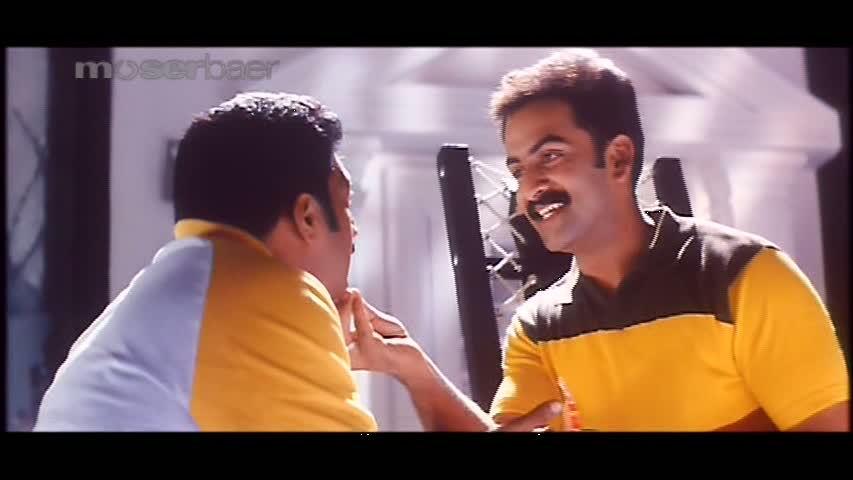


Ah! Gold! Each and every one of their scenes! Such goofs!

Which actually brings me to a little something I wanted to say about Prakash Raj. Now I know he's been in some hundred of films, but why is it that there are only a handful where he plays a character different from Prakash-Bad and Prakash-Dad? If there was any doubt, Mozhi proves that he can do it and well, so I confess to being a little disappointed with him for not doing more with this talent. Not that I don't appreciate Prakash-Dad and Prakash-Bad, God knows I will watch a bad movie if he is the villain any day, but films like Mozhi and Iruvar make me sad to see him typecast so much.

Speaking of wasted potential, I am not Jyothika's biggest fan, but she truly made this role one of her best performances. Such a shame that she gave up acting after this film. She seems to have trouble emoting sometimes (and a few times in this film), but the fact that she made the sign language work so fluently for her character and pulling off a role where she has no lines, is indeed commendable. I quite enjoyed her in this film, as I enjoyed her sidekick, Swarnamalya.


It would not be a complete review if I didn't mention all the secondary characters, neighbours from the apartment complex, but then, this was never meant to be a proper review, nor do I want to spoil some of the surprises by bringing them up here. Suffice to say, it's a pleasure to see some well-developed secondary characters who are not there to move the plot forward necessarily, but rather to populate and enrich a world that becomes more real with each of them.

Now that Mozhi is available on DVD with subtitles, there is no excuse for not watching it. Besides, how often do you hear me rave so much about a love story, huh?

Sunday, October 2, 2011

Anandabhadram Review

While I am sure everyone reading this blog knows about my undying love for cinematographer/director Santosh Sivan, who can do no wrong as far as this blogger is concerned, I need to also make sure everyone is aware of my newest crush, Malayalam actor Prithviraj. Because you know, this review may be (read: IS) partially (read: completely) influenced by this little detail. But I promise to try and keep it real. Emphasis on "try".

The film starts with a lovely scene where a mother tells her son about the legend of the Sivakkavu temple, an ancient place where the diamond containing the soul of the world is kept.


Evil sorcerers have tried to snatch it to obtain its power, but the little snake Kunjoottan protects it with the help of the locals. However, the temple has fallen in ruin and is now host to Digambaram's blood sacrifices. The powerful sorcerer is, as his predecessors, in search of a way to obtain the diamond hidden in the temple.


Anandabhadram belongs to the fantasy genre of Indian cinema. You know, the genre based on local legends, with black magic priests, guardian snakes, temple goddesses and power rings. Yeah, the genre that usually goes all kinds of wrong in the hands of other directors. Thankfully, Santosh Sivan manages to do it justice, despite a rocky beginning.

Namak: Oh God, those white people on the train in the beginning were just awful. What was the point of that anyway?
Dolce: To introduce Anandan as the son and the other villager, I suppose, but yes, pretty awful stuff.
Namak: You know, why is it that in Indian movies everyone who comes from "foreign" (be they Indian born or not) has to appear slightly retarded? There have been a few instances just in the past 6 months where that really bugged me: Delhi Belly, Mere Brother Ki Dulhan, The Householder and now this one. Really guys, not every pardesi/firangi is a caricature! Prithviraj took a good half of the movie to start acting like a normal person instead of the hyper doofus he appears to be in the beginning.
Dolce: It may be some sort of subliminal patriotic message. But either way, I was too busy making fun of the goofy moustache to notice. At least until this moment, when it really stopped being goofy.


Namak: Right, well, there goes that intelligent conversation...

The film gets better once Anandan gets to his mother's village and the pace is very well maintained throughout. Even the suspense, which most Indian films have trouble with, is kept up well. And the tale takes some interesting turns as more pieces get added to the puzzle. It may not be a terribly layered story, but it's definitely a well told one, which is more than enough for me.

The fantasy premise of the film doesn't allow for too much social commentary, except for one moment towards the end, which I will discuss in the spoiler paragraph.

**SPOILER for the END**

So as it turns out, the only way to defeat the evil sorcerer is to rob him of his powers obtained through chastity. In other words, someone has to rape him. While I am not typically a violent or vengeful person, I did find this twist particularly delightful because this is the first time I am seeing a man losing everything along with his virginity, while we see women raped and their lives destroyed by this virtually all the time in movies. It felt rather satisfying, even if someone had to make a sacrifice in order for this to happen (which makes for a whole other discussion, but I suppose in Sivan's defense, we could claim that her life had already been compromised and revenge was the only possible solution).


**SPOILER OVER**

This film is surprinsingly tame for a Santosh Sivan offering, not his usual visual extravaganza, and in a way it reminds me more of Mani Ratnam films. Granted, all Mani Ratnam films that Sivan did the art direction for, so I suppose it's all coming from the same source anyway. Just a few screencaps to illustrate:


A girl's innocent surprise in front of her own beauty, such a Mani Ratnam staple!


That last one reminds me a lot of Raavan/Raavanan, which also makes me wonder, after seeing Prithviraj in the second half of Anandabhadram when the evil forces take over: what would he have done with the role of Beera/Veera in Raavan instead of Abhishek/Vikram? Food for thought...

Despite some similarities to other film makers, Santosh Sivan still makes this movie all his by adding some of his favourite little quirks: those reverse spinning shots and the rivers of fabric in this song:


...mist-filled close-ups like this one:


...and I am pretty sure I saw Chemban training with an urumi for a brief 3 seconds!


Also, unlike many film makers, especially in this genre, Sivan knows how to keep his focus on the topic at hand and to not try to cram too many sidestories. Is it any wonder, with a name like Santosh, that I'm always ridiculously happy while watching his movies?

Apart from the visuals, which are exquisite, the other forte in a Sivan movie is also present: gorgeous songs. The concept of Pinakkamano in particular made me giggle with delight: it's a song set inside a series of paintings! Now what can I possibly want more?


Dolce: And a special shout out to the actresses in this film! 
Namak: Right, Kavya Madhavan, Riya Sen and Revathy all do a fantastic job, almost outshining the men.
Dolce: Ok, you need to get over this issue you have with Prithvi in the first half. He was great after he became normal and fell in love with the village girl. He even forgot to say "interesting" all the time.
Namak: Nope, not letting go, I will not have my boy overact just to show how dumb foreigners are. It was silly and I will not get over it.
Dolce: Suit yourself. I'll forgive him anything after that sexy chemistry with Kavya.

We wonder, as we always do, what will happen to these characters after the closing credits, as this is another one of those stories where things cannot possibly go smoothly what with the different backgrounds, and different views of the world that each half of the couple brings to the table, but I really don't think we are supposed to go this far. I did however appreciate that despite the strict parental control, some of the elders in this village were enlightened enough to root for the blooming romance with the "man from foreign", and the village belle herself was not exactly the sheltered type. There's no shying away from holding hands and sharing embraces, so Bhadra is definitely my kind of girl.

And one last random thought: Oh my, how gracefully Revathi has aged since Mouna Ragam! She still lights up the screen with that smile!

Aye haye, what a beauty!


Anadabhadram is like Provolone cheese: smooth, tender and buttery without too many strong notes. It leaves a sweet impression and you crave the texture of it often, despite it not being a strong cheese. It's easy on the taste buds just like Anandabhadram is easy on the eyes and light enough to not weigh you down at the end.

Sunday, June 12, 2011

Celebrating Magical Realism: Road Movie and Nandhanam

Magic realism--a kind of modern fiction in which fabulous and fantastical events are included in a narrative that otherwise maintains the 'reliable' tone of objective realistic report. Designating a tendency of the modern novel to reach beyond the confines of realism and draw upon the energies of fable, folk tale, and myth while maintaining a strong contemporary social relevance. (The Concise Oxford Dictionary of Literary Terms)

Magical realism, now that I think about it, is hard to find in Indian movies. A bit odd considering they come from a culture brimming with superstitions and religious beliefs. But no matter.

I am always happy to see a film that uses magical realism precisely because they are so few and far between. Moreover, out of these few films that delve into it, there are even fewer I actually like (sorry, Paheli and Videsh, you failed miserably to impress me). Which is unfortunate because for example most of my favourite authors (Salman Rushdie, Jose Saramago and to a certain extent Gabriel Garcia Marquez) can sell me just about anything written in this style.

So today I want to celebrate two magical films that I love unconditionally: Road Movie (Hindi) and Nandhanam (Malayalam).


I saw Road, Movie at the Toronto Film Festival in 2009 and I never though I would be able to recreate the high that possessed all of us when we came out of the theatre. So I admit to being a little afraid to rewatch it after getting the DVD. But it turns out it's just as powerful the second time around as I remember.

Road, Movie takes us on a journey across the Rajahstani desert in an old movies truck, along with Vishnu (Abhay Deol), a mechanic (Satish Kaushik), a kid (Mohammed Faisal) and a gypsy woman (Tannishtha Chatterjee). "In the desert", as another beloved Abhay Deol movie points out, "nothing is what it seems." Elements of magical realism come up more than once in surprising ways that elevate this film from a simple road movie (pun intended) to a glorious magic carpet ride.

And before I stray away from the theme, let me introduce the other lovely piece of art that is responsible for my taking a break from Kapoor Khazana to write this post: Nandhanam.


Nandhanam is the story of the beautiful servant girl and Krishna devotee Balamani (Navya Nair) who falls in love with the very handsome and very straightforward young master of the house: (Prithviraj). Status, family honour as well as the ever powerful sense of duty towards one's parents keep them apart. But the God Krishna is there looking out for them. Of course for the purposes of this post I will pretend that the annoying comedy track does not exist in this film. In fact, I strongly suggest you do the same with the help of our ever-faithful friend: the fast-forward button.

These two stories have nothing in common other than the above mentioned elements of magical realism. But because that is so hard to find, I am celebrating them both in the same post.


Road, Movie 

Gypsyes with their transitory nature and documented restlessness are often used to make the transition between what is real and what is magical in all kinds of stories. This happens a lot in Eastern European art, one great example being Emir Kusturica's films. So it's somewhat fitting that one of the characters in Road Movie is a mysterious gypsy woman without a name and without a home.


From the moment Vishnu's truck is started and until its dismissal at the end of the film, the real world is just a backdrop. None of the characters even behave as they would in the real world: they don't ask each other questions about their background, they don't chat needlessly, they just accept each other for what they are right there and then. To enhance that sense of fable, none of the people that Vishnu meets have a name, nor are they asked for one. It's this air of surrealism, or better said of fake realism, that makes Road Movie so very special.

The scenery with its endless roads of yellow dust and pebbles also contributes to the outlandish feel. Not surprisingly it brings to mind Giorgio de Chirico's deserted, desolate landscapes, a background not uncommon with other surrealist painters such as Yves Tanguy and Salvador Dali.


Of course, as is usually the case with magical realism, the fantastical elements are well balanced by pertinent social commentary and characters well anchored in the real world: police officers, goondas, villagers. The water women that appear at key moments throughout the film somehow seem to belong to both worlds, making the transition smoother.


And because biting irony is always a sure sign of realism, we find plenty of it all along the movie, culminating with the biggest irony of them all: instead of selling the hair oil as instructed, Vishnu exchanges it for water, a commodity only precious on the rare occasions when it is lacking. But then that is the key to the whole movie, isn't it: it's the things we take for granted, like water, life, laughter, and even a good hair oil massage that end up teaching us the big lessons.

Very much connected to the magical realism theme, everyone always asks about the fair scene, as they do not find it real enough for the film. This question was asked a couple of times of Dev Benegal at the Film Festival and he shrewdly evaded the answer. I've also seen the resolution of the Waterlord conflict being judged by the same criteria. But what I always want to reply to these critics is: where do you draw the line to define realism in a movie like this? If the Fair is not real, is the Waterlord episode more real? If that is also preposterous, is the police station more real? Is the journey itself? Are the people in the story? Is that ancient truck any more real? You see how this can go on endlessly. And after all, the real question is: does it really matter?


The beauty of magical realism is that it doesn't question itself: things happen the way they are told, when they are told, and that's final. Why then question the movie when it does not doubt itself? You know it can't happen, that it's logically impossible, and yet here it is happening in front of your eyes, and guess what: it's on purpose, it's not a continuity mistake nor is it a dream sequence. In the simple words of Salman Rushdie: "It happened that way because that's how it happened." (Midnight's Children)


Nandhanam

Rushdie's words can easily be transferred to the more straight-forward Nandhanam, where (and this is hardly a spoiler because it's evident right from the beginning) the God Krishna's involvement in Balamani's life alters the elements in the story, thus recreating reality. Balamani herself seems to question it but she ends up accepting it as a fact, which is of course exactly how the story should go. A devotee of Krishna, Balamani has a very personal relationship with her most revered God, where she sees him more as her confidante than anything else. Much of the time spent in her room consists of conversations with Krishna as if he were a diary. But more than a diary, she treats him like a real person, a friend that you can get mad at, call upon in the middle of the night for help, look to for comfort and admit your deepest fears to.


It's hardly surprising then that his involvement in the story would reach beyond the frames of his icon.

Nandhanam is a classic fairy tale complete with a prince who falls in love at first sight and powerful forces of evil (in the shape of family honour and uncompromising relatives). We cannot judge the characters for being so kind it renders them weak because they are not here to teach us about rebellion, they are here to teach us about faith.


We also cannot judge the evil forces and their excuses and predicaments for the same reason: their existence validates the story.


At the same time, most of the characters, good or bad, bring about credible social commentary and the mentalities of the middle class family are captured eloquently. It's not that we've never seen a love story where the family opposes the union, but we rarely see a story that paints such an expressive picture of all the factors that influence this group decision. We also rarely see stories where folklore or gods have any kind of impact on the fate of the couple and this makes Nandanam very special.

Nandhanam, let's face it, is not a terribly complex movie, but it's a story with its heart in the right place and that little smidgen of magical realism truly makes it memorable. Because behind the very astute portrait of societal norms, the magical element brings about a very important question: can faith truly move mountains? Can wishing for something with a pure heart truly alter the course of your destiny? It's nice to be reminded to think of that every once in a while and that's exactly what Nandanam with its simple love story and simple people does.


Which brings me to the realization that perhaps that's why I love magical realism so much: it makes me wonder about all those layers beyond the visible and tangible world we live in, but at the same time it does so without demanding anything of me. I am not required to be religious, in fact I'm not even required to buy the story. I just have to... go with it. I'm certainly glad I "went with" both Nandanam and Road Movie.