Showing posts with label Santosh Sivan. Show all posts

Sunday, October 2, 2011

Anandabhadram Review

While I am sure everyone reading this blog knows about my undying love for cinematographer/director Santosh Sivan, who can do no wrong as far as this blogger is concerned, I need to also make sure everyone is aware of my newest crush, Malayalam actor Prithviraj. Because you know, this review may be (read: IS) partially (read: completely) influenced by this little detail. But I promise to try and keep it real. Emphasis on "try".

The film starts with a lovely scene where a mother tells her son about the legend of the Sivakkavu temple, an ancient place where the diamond containing the soul of the world is kept.


Evil sorcerers have tried to snatch it to obtain its power, but the little snake Kunjoottan protects it with the help of the locals. However, the temple has fallen in ruin and is now host to Digambaram's blood sacrifices. The powerful sorcerer is, as his predecessors, in search of a way to obtain the diamond hidden in the temple.


Anandabhadram belongs to the fantasy genre of Indian cinema. You know, the genre based on local legends, with black magic priests, guardian snakes, temple goddesses and power rings. Yeah, the genre that usually goes all kinds of wrong in the hands of other directors. Thankfully, Santosh Sivan manages to do it justice, despite a rocky beginning.

Namak: Oh God, those white people on the train in the beginning were just awful. What was the point of that anyway?
Dolce: To introduce Anandan as the son and the other villager, I suppose, but yes, pretty awful stuff.
Namak: You know, why is it that in Indian movies everyone who comes from "foreign" (be they Indian born or not) has to appear slightly retarded? There have been a few instances just in the past 6 months where that really bugged me: Delhi Belly, Mere Brother Ki Dulhan, The Householder and now this one. Really guys, not every pardesi/firangi is a caricature! Prithviraj took a good half of the movie to start acting like a normal person instead of the hyper doofus he appears to be in the beginning.
Dolce: It may be some sort of subliminal patriotic message. But either way, I was too busy making fun of the goofy moustache to notice. At least until this moment, when it really stopped being goofy.


Namak: Right, well, there goes that intelligent conversation...

The film gets better once Anandan gets to his mother's village and the pace is very well maintained throughout. Even the suspense, which most Indian films have trouble with, is kept up well. And the tale takes some interesting turns as more pieces get added to the puzzle. It may not be a terribly layered story, but it's definitely a well told one, which is more than enough for me.

The fantasy premise of the film doesn't allow for too much social commentary, except for one moment towards the end, which I will discuss in the spoiler paragraph.

**SPOILER for the END**

So as it turns out, the only way to defeat the evil sorcerer is to rob him of his powers obtained through chastity. In other words, someone has to rape him. While I am not typically a violent or vengeful person, I did find this twist particularly delightful because this is the first time I am seeing a man losing everything along with his virginity, while we see women raped and their lives destroyed by this virtually all the time in movies. It felt rather satisfying, even if someone had to make a sacrifice in order for this to happen (which makes for a whole other discussion, but I suppose in Sivan's defense, we could claim that her life had already been compromised and revenge was the only possible solution).


**SPOILER OVER**

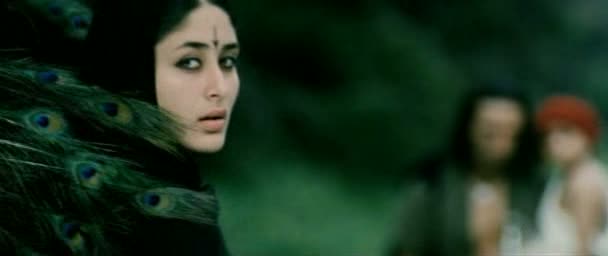
This film is surprinsingly tame for a Santosh Sivan offering, not his usual visual extravaganza, and in a way it reminds me more of Mani Ratnam films. Granted, all Mani Ratnam films that Sivan did the art direction for, so I suppose it's all coming from the same source anyway. Just a few screencaps to illustrate:


A girl's innocent surprise in front of her own beauty, such a Mani Ratnam staple!


That last one reminds me a lot of Raavan/Raavanan, which also makes me wonder, after seeing Prithviraj in the second half of Anandabhadram when the evil forces take over: what would he have done with the role of Beera/Veera in Raavan instead of Abhishek/Vikram? Food for thought...

Despite some similarities to other film makers, Santosh Sivan still makes this movie all his by adding some of his favourite little quirks: those reverse spinning shots and the rivers of fabric in this song:


...mist-filled close-ups like this one:


...and I am pretty sure I saw Chemban training with an urumi for a brief 3 seconds!


Also, unlike many film makers, especially in this genre, Sivan knows how to keep his focus on the topic at hand and to not try to cram too many sidestories. Is it any wonder, with a name like Santosh, that I'm always ridiculously happy while watching his movies?

Apart from the visuals, which are exquisite, the other forte in a Sivan movie is also present: gorgeous songs. The concept of Pinakkamano in particular made me giggle with delight: it's a song set inside a series of paintings! Now what can I possibly want more?


Dolce: And a special shout out to the actresses in this film! 
Namak: Right, Kavya Madhavan, Riya Sen and Revathy all do a fantastic job, almost outshining the men.
Dolce: Ok, you need to get over this issue you have with Prithvi in the first half. He was great after he became normal and fell in love with the village girl. He even forgot to say "interesting" all the time.
Namak: Nope, not letting go, I will not have my boy overact just to show how dumb foreigners are. It was silly and I will not get over it.
Dolce: Suit yourself. I'll forgive him anything after that sexy chemistry with Kavya.

We wonder, as we always do, what will happen to these characters after the closing credits, as this is another one of those stories where things cannot possibly go smoothly what with the different backgrounds, and different views of the world that each half of the couple brings to the table, but I really don't think we are supposed to go this far. I did however appreciate that despite the strict parental control, some of the elders in this village were enlightened enough to root for the blooming romance with the "man from foreign", and the village belle herself was not exactly the sheltered type. There's no shying away from holding hands and sharing embraces, so Bhadra is definitely my kind of girl.

And one last random thought: Oh my, how gracefully Revathi has aged since Mouna Ragam! She still lights up the screen with that smile!

Aye haye, what a beauty!


Anadabhadram is like Provolone cheese: smooth, tender and buttery without too many strong notes. It leaves a sweet impression and you crave the texture of it often, despite it not being a strong cheese. It's easy on the taste buds just like Anandabhadram is easy on the eyes and light enough to not weigh you down at the end.

Tuesday, May 10, 2011

Asoka vs Urumi and Why I Adore Santosh Sivan


After seeing Santosh Sivan's Urumi on the big screen I kept struggling to put another DVD in the player as I had just enough time to watch a movie, but somehow it didn't seem right to wash off the sweet images hanging in each corner of my memory with some other film. Then I remembered that there was one I had been meaning to rewatch which would in fact enhance the memories instead of erasing them: the "other" Santosh Sivan historical, Asoka.


The film tells the story of the early life and deeds of the emperor Asoka, known for his cruelty and conquests, who would later renounce the way of the sword and travel the country to spread the light of Buddhism. It's not a very popular film and I am not entirely sure why. Maybe something to do with it being built on a (beloved?) historical figure most known for his good religious deeds? Maybe something about it being a modern love story in the guise of a historical? Maybe the fact that Shah Rukh Khan actually attempted a different role that did not please his fans? Maybe the inaccuracies which I would know nothing about? It doesn't matter, because from where I'm standing all these reasons are blocked from my sight, so I love it.

I may have gushed on other occasions about my love for Santosh Sivan's artistry, so I won't go over that again, but he is one of only a handful of directors who can make me watch the grass grow in real time without boring me for one second. Asoka was the first movie to convince me of that.

Urumi employs some of the same storytelling devices as Asoka, but it's a much simpler story: it's the story of a warrior out to fight Vasco da Gama's cruelty and with that, Portugal's imminent monopoly on the trading routes from India. I watched Urumi without subtitles and it is a very dialogue heavy film, so a proper review for it will come when the DVD *coughBluRaypleasecough* comes out, but for now I just wanted to put the two films in front of each other and look into the similarities and the reasons that make both of them so fabulous to me.

The Hero

Santosh's hero in Urumi is a powerful display of physicality. We all know that Prithviraj can act, but that did not come first on his list of requirements in Urumi. Badassness did. And that is just fine by me because a warrior needs to be valiant and manly first, and only then can he waste time with trivial dialogue. The character development did not find much room for growth because of that, so Kelu starts off as a perfect hero and ends up the same way. But this is not the type of story that calls for introspection or reflection, so we're happy to just see him slashing through the bad guys and being the perfect embodiment of the strong silent type.


In that respect Shah Rukh's requirements seem to have been the exact opposite. He does well with his displays of testosterone swordsmanship but they are overpowered by his displays of gallantry. Also, his evolution from teenage behaviour to ruthless warrior to finally grow into the man that was known for spreading Buddhism in India makes for a fascinating watch, and it definitely is one of the main reasons why Asoka holds a special place in my heart. A hero battling his demons can be just as engaging as a hero fighting his enemies.


The split personality and his inner conflicts make Asoka far more interesting a hero than Kelu, but that could also be why the film flopped, so I understand the need for a cleaner character. Also I wouldn't know if there were any dark shades in Urumi as I didn't understand any of the dialogues. I would be pleasantly surprised if there were.

The Heroine

Sivan's heroine on the other hand is half woman and half warrior, just the right mix of defiance and sexuality. She is vulnerable because she wants to, not because she's helpless. I can definitely see why the two heroes are attracted to her. Unfortunately for her, Genelia is at a disadvantage because she looks like an awkward teenage boy. This role demanded some curves, some grace, some poise which Genelia doesn't have, in other words she needed to be more woman. Not her fault, she just doesn't look the part. If a woman is to be appealing as a warrior, she must ooze fertility, just like the hero oozes testosterone, otherwise the effect is lost.

Genelia, in order to truly look the part, needed to be this:

and this:

and at the same time, this:


But she only manages to be... this:

Sigh... rather bland. But that's ok, because on the other hand Prithviraj was 100 times the hero that Shah Rukh the loverboy was not. Oh, a film with Kareena as the warrior heroine and Prithviraj as the fearless hero... What a dream that would be!

The Couple Dynamics

We had a lot more fun than we should have watching Kelu and Ayesha's scenes of... courtship (we called it foreplay) where they slash people's throats while staring longingly and menacingly into each other's eyes. It sounds strange, but I find that Sivan likes that kind of dynamic a lot in his couples. It's like love is a fight between the sexes and he will not take displays of weakness from either of them. Philosophically speaking, that's a pretty cool way of looking at it.

I noticed the same kind of relationship between Asoka and Kaurwaki who turn their love scenes into playful battles as well. Granted, that also made Asoka look more like a 90s romantic film than a historical and Sivan seems to have learned from that because he avoided making the same mistake with his main couple in Urumi.

Comic Relief

But flirting as we know it from modern films is not altogether absent in Urumi. It simply gets transferred to the other couple, Kelu's sidekick Vavvali (played by a delightful Prabhu Deva) and his bratty love interest Bala (Nithya Menon). They also serve as the comic relief characters of the film, which decidedly works a lot better than the poorly integrated comic side-plot in Asoka, involving some soldiers and a foxy narrator.


And speaking of relief, though not necessarily comic this time, Urumi also avoided using annoying children as part of the plot. Thankfully! If there is one thing and one thing alone that single-handedly made Asoka unbearable for me it's the little prince Arya. It took a lot of love for everything else in the film for me to get over just how annoying that child actor could be. Granted, the role called for heavy doses of brattiness and entitlement, so the blame does not lie entirely with the poor child actor, but sadly that does not make him more watchable.

The Visuals

Now let's face it, one doesn't always watch a Santosh Sivan film primarily for the plot. Because Sivan has been and will always be a cinematographer at heart, and he never lets us forget that. From the rich jungles of Before the Rains to the symbolically arid backdrop of Tahaan, Sivan's passion for photography never lets his stories down.


Unarguably his most beautiful sets are the great outdoors: lush, misty, humid, fertile with water and greenery. Santosh Sivan's landscapes always look so fresh you want to just take a bite out of them, he invents new colours and textures that nature never knew it had. He also has a knack for finding the world's most delightful waterfalls and using them creatively. The man could make a movie out of a single drop of water and I love him for that. This is one of the reasons I started watching Indian films to begin with and that fascination has not waned ever since.

From this point of view the less action-packed Asoka lingers more on the scenery especially in the first half where it is an integral part of the blossoming love story.


Urumi gets a more concise treatment, though just as beautiful and engaging. Because it's a faster paced story, the forces of nature seem to move faster as well: roaring waterfalls, storms at sea, whirlwinds of fire and smoke...


Every bit as delicious as one would expect from a director like Santosh Sivan.

It would not be fair to talk about the cinematography in Asoka and Urumi without talking about the impressive fights.


Urumi definitely has the better ones, not just because the choreography is a spectacle in itself, but because he combined a great deal of tricks: funky angles, slow motion shots, surreal leaps and twirls in the air, which made for some truly memorable scenes. On the downside, he cheated in this particular one by desaturating the colours during fights. It looked fabulous, there's no denying it, but the transitions were always abrupt enough to make it noticeable. For that reason, I have a feeling I will appreciate the DVD experience a lot more than the big screen because my TV will probably be a lot more forgiving.

Urumi picks up a few of the techniques essayed in Asoka and gives them the royal treatment, which is something I had always secretly wished for when watching the few sword fights and war scenes in the earlier film.

The Symbolism

Maybe because I've already watched Asoka a few times, but I like the symbolism in it better: from Asoka's black and white horses one for each side of his character to the war scenes where his dark side is preventing him from reuniting with a Kaurwaki whom he doesn't yet deserve; from the white ash smeared on the hero's face when grieving for his loved one to the peacock feathers that bring her to his memory every time; from the first conversation prince Asoka has with the monks straight through to his final recognition of the frailty of emperors and rulers... Asoka keeps giving me reasons to rewatch it in hopes of uncovering even more layers every time.


I'm sure Urumi's breathtaking visuals have their own hidden layers and meanings, but I couldn't pick up on them the first time around. The ones I did pick up on seemed too close to the surface and therefore not interesting: the shower of pepper on Vasco Da Gama's body; the gunpowder defeating traditional weapons just like in the present time story progress will destroy tradition; and of course how can we forget the sword itself, a symbol with many meanings: tradition, legacy, valour, manhood. And of course, by being quintessentially South Indian the urumi is a great antonym to the foreign invaders. Because Urumi is at the core an "us versus them" tale, no matter how we spin it.

Which brings me to the last point of differentiation between these two films, and that is the story itself. While Asoka is a journey of discovery, a voyage that takes the hero across experiences and emotions that will guide the main character to his final destination, Urumi is a much more straight-forward revenge saga. But where Urumi loses points on character development and sense of purpose, it gains them right back in tightness of pace and suspense. Because sometimes... you just want to see the hero triumph.

Final word...

I started off writing this thinking I would find plenty of similarities between Asoka and Urumi, Sivan's two great historicals. But as it turns out, they could not be any more different, which is a very pleasant conclusion to arrive to.

Now... on to wait for the Urumi DVD while pretending that I never heard of a shorter international version being in the works for festivals and Western audiences. And of course, on to feed my newly spawned Prithviraj crush!